


MANUFACTURING A CABINET ACCORDING TO SYSTEM 32 STANDARD
Assistent templates allow you to use the advantages of System 32 in the creation of custom furniture without the height and width constraints imposed by the System 32 standard.
The explanations below are given for information on the rules of System 32.
The manufacture of a cabinet or box, according to system standard 32, imposes strict rules to be respected for the height and width of the cabinet.
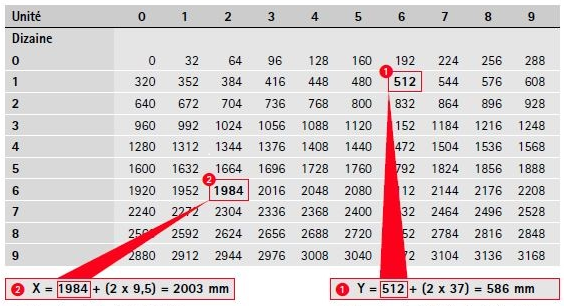
X and Y must be multiples of 32 mm (see fig. below)
B = is the distance between the upper or lower edge and the axis of the first hole.
This distance corresponds to the thickness of the panel which is divided by 2.
For a panel thickness of 19 mm divided by 2 => B = 9.5 mm

Calculation formula for furniture height and width.
Calculation of the amount of furniture:
Height = X + (2 XB)
Width = Y + (2 X 37 mm)
Example :
- Desired height approximately 2000 mm
- Desired depth approximately 600 mm
- Panel thickness = 19 mm
- VB or Rastex assembly fittings
Based on the correspondence table below:
- For the X dimension choose 1984 in the correspondence table. The cabinet height is therefore 1984 + (2 x 9.5) = 2003 mm.
- For dimension Y (600 - 2 x 37) choose 512 mm in the correspondence table.
The cabinet depth is therefore 512 + (2 x 37) = 586 mm.
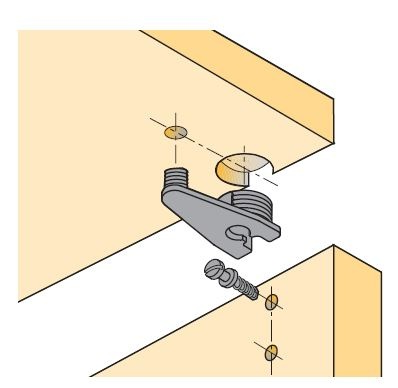
Assembly with Type VB36 fittings:
Type VB36 fittings are used either for assembling the box (cabinet) or for installing reinforcement shelves.
The advantage:
Possibility of installing a shelf even if your box or cabinet is already assembled.
Does not require additional space for shelf assembly.
Easy and quick disassembly.


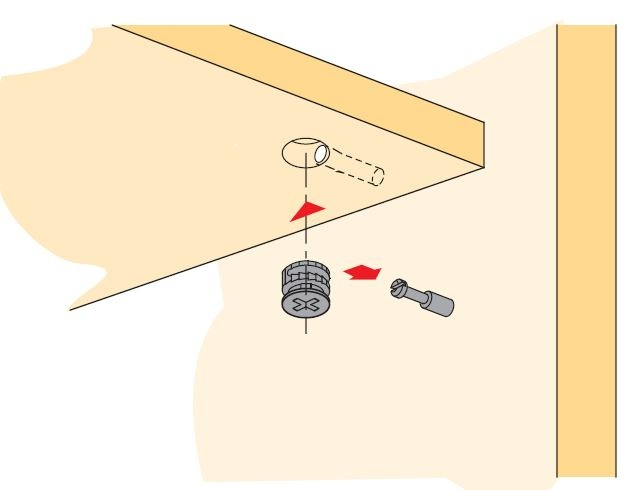
Assembling the box with studs and Rastex type eccentric (Minifix box)
It is the assembly most used by kitchen and furniture manufacturers.
The advantage:
Allows quick assembly but requires a minimum space of 2 x the size of the studs used especially in tight spaces
Easy and quick disassembly.
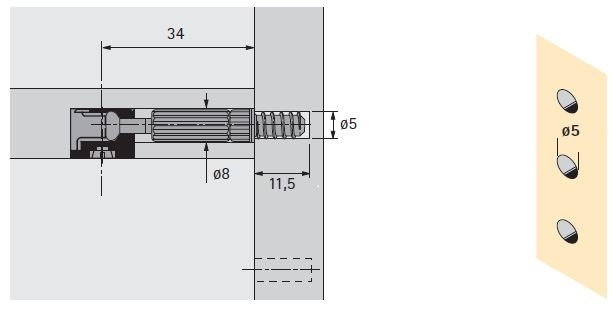
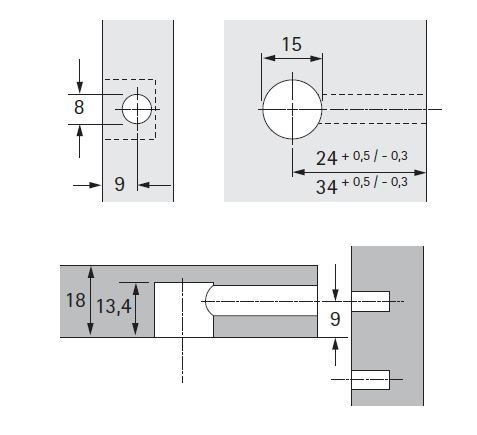
Rastex assembly (Minifix eccentric box) for 18 mm panel
For 18mm thick panels you can use 20.3mm dowels with a 24mm countersink.
Or 30.3 studs for 34mm countersinking.
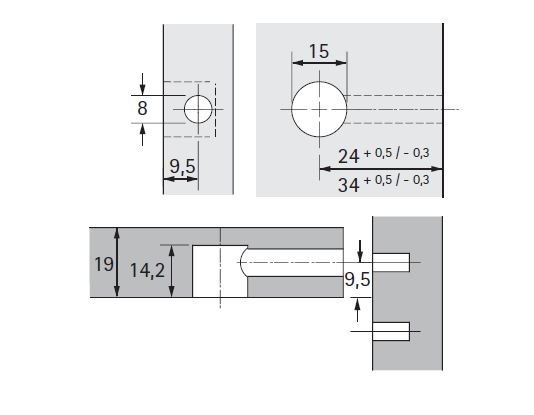
Rastex assembly (Minifix eccentric box) for 19 mm panel
For 19mm thick panels you can use 20.3mm dowels with a 24mm countersink.
Or 30.3 studs for 34mm countersinking.
Installing the hinges
A = distance from the upper door edge to the center of the hinge housing
B = distance from the upper edge of the upright to the center of the dowel
F = door recess or projection
X = multiple of 32 mm

Hinge distance calculation formula:
A = B + X - 16
9.5 + 96 - 16 = 89.5mm
Add or Remove a desired door recess (protrusion) F, in principle for kitchen cabinet doors we leave 1 mm of clearance at the top and 1 mm of clearance at the bottom.
Installation of standard system 32 type A - B hinges for total coverage of the box by the door.
The base is located in relation to the edge at 37 mm
The milling of the diameter 35 pivot is 22 mm from the edge

Installation of standard system 32 type C hinges for a door inside the box.
The base is located in relation to the edge at 37 mm + the thickness of the door.
For a door thickness E = 19 mm => 37 + 19 = 56 mm
The milling of the diameter 35 pivot is 22 mm from the edge

Source of some images: Hettich - Blum – Hafele - Assistent